
Deciding whether to invest in a significant automotive repair or transition to a newer vehicle is a common dilemma for motorists across the Greater Toronto Area. In the harsh climatic conditions of Southern Ontario, where road salt and extreme temperature fluctuations accelerate chassis corrosion and mechanical wear, the “age” of a car is often measured by its structural integrity rather than the odometer reading. For many owners of aging sedans or SUVs, the mounting cost of annual safety inspections and unexpected breakdowns eventually crosses a threshold where the vehicle ceases to be an asset and becomes a recurring liability.
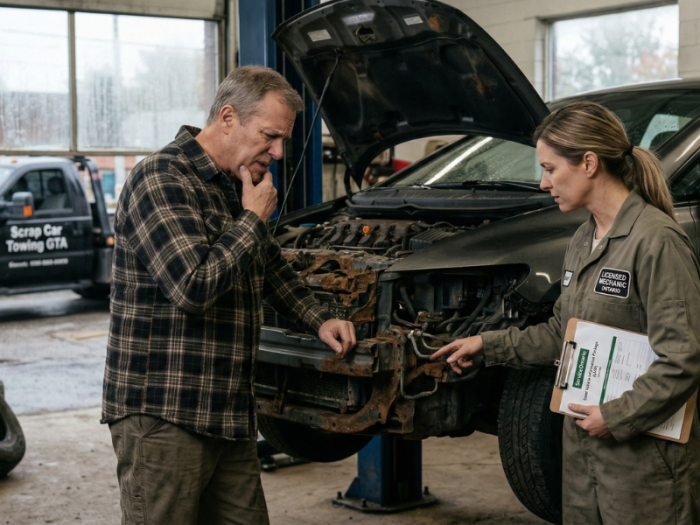
The decision-making process typically begins when a mechanic presents an estimate for a major component, such as a transmission overhaul, engine gasket replacement, or comprehensive suspension work. When the repair bill is higher than the car’s actual value, it might be time to cut your losses. Local services like ScrapCarsGTA offer free towing and pay cash on the spot, making it easy to get rid of a vehicle that’s beyond saving. This transition is often driven by the “50% Rule,” a standard industry benchmark suggesting that if a single repair exceeds half the vehicle’s total market value, the financial return on that investment is virtually non-existent in the current secondary market.
The Tipping Point: Evaluating Maintenance vs. Replacement
One of the most important distinctions for an automobile owner is the difference between maintenance and repairs. Maintenance includes predictable services such as oil changes, brake pad replacement, and tire rotations. These costs are expected and can be budgeted in advance. Repairs, however, involve components that have failed due to age or accumulated stress. When one system fails, others may be nearing failure as well. In the Greater Toronto Area, many owners notice that after roughly twelve years of ownership, repairs become more frequent.
The cost of owning a vehicle that regularly breaks down can exceed the difference in monthly payments between an older car and a newer one. Lost wages from time off work, emergency towing from highways such as the 401 or the Don Valley Parkway, and the stress of a vehicle that will not start on a -20 February night all add up. Over time, repeated withdrawals from an emergency fund to handle ongoing issues can surpass the perceived savings of avoiding a car payment.
The Step-by-Step Viability Assessment for GTA Drivers
Determining the future of a vehicle requires a structured approach. Owners should consider the following checklist when evaluating whether their car is nearing the end of its useful life:
Structural Integrity Check: Inspect the frame, sub-frame, strut towers, and brake lines for hidden rust. In Ontario, cosmetic rust on body panels may be manageable, but perforation or deep scaling of structural components is often considered non-repairable and can prevent a vehicle from obtaining a Safety Standard Certificate (SSC).
The $2000 Safety Hurdle: If the cost to bring a vehicle to roadworthy condition exceeds $2,000, it is generally not worth repairing. Common issues in older vehicles driven on salted roads include rusted fuel lines and other labour-intensive replacements.
Drivetrain Health: Evaluate the condition of the transmission and engine. Slipping gears or excessive oil consumption between changes may indicate the vehicle is approaching the end of its service life.
Market Comparison: Review listings for the same make and model in your area, such as North York or Mississauga. If repairs total $3,000 but the vehicle’s market value in good condition is $4,000, the repair is not cost effective.
Common Pitfalls in Ontario’s Secondary Market
One of the most frequent mistakes made by Ontario vehicle owners is the “Sunk Cost Fallacy.” This occurs when a driver decides to spend $1,200 on a new alternator because they “just spent $800 on tires last month.” They feel they must keep the car to “get their money’s worth” out of the previous repairs. However, in the automotive world, money spent on past repairs does not increase the future reliability of unrelated parts.
Selling a vehicle with mechanical problems privately can also present challenges. Even when described as a “mechanic’s special,” a Used Vehicle Information Package (UVIP) is still required. Vehicles that cannot pass safety inspections attract limited interest, often restricted to recyclers or enthusiasts who may offer less than the owner expects. Negotiating with multiple potential buyers can be time consuming. In contrast, the cash-for-scrap process is typically completed within a single day.
Documentation and Legal Requirements
When disposing of a vehicle in Ontario, specific provincial regulations must be followed to ensure proper transfer of responsibility. The Ministry of Transportation has established procedures for ownership transfer and environmental compliance.
1. The UVIP: Whether selling to a scrapyard or a private buyer, obtaining a Used Vehicle Information Package helps confirm there are no outstanding liens on the vehicle.
2. Permit Transfer: The Application for Transfer on the reverse side of the green vehicle permit must be completed and signed. The vehicle portion is provided to the buyer, while the plate portion remains with the owner.
3. Plate Return: Licence plates must be removed and taken to a ServiceOntario centre. Plates belong to the individual and may qualify for a partial refund of unused validation or be retained for future use.
4. Proof of Sale: Obtain a signed receipt or bill of sale that includes the Vehicle Identification Number (VIN), date, and selling price. This protects the seller if the vehicle is scrapped or involved in an incident before ownership records are updated.
Establishing a Financial Exit Strategy
Owners who establish a predefined “hard limit” on repair spending often approach the decision more objectively. For example, setting a rule such as not spending more than $1,000 on any single repair can remove emotional factors from the replacement decision.
The salvage market in the Greater Toronto Area remains active due to demand for recycled steel and used parts. Typical scrap values for mid-sized sedans and older SUVs range between $200 and $600. Although this is lower than the sale price of a functioning vehicle, the process can often be completed within 24 hours, providing immediate resolution for owners who need to clear space quickly.
Ultimately, when a vehicle reaches the end of its useful life, continuing to invest in repairs may no longer be financially rational. Recycling the vehicle and reallocating funds toward a newer pre-owned model or public transportation can provide a more stable and predictable transportation solution.