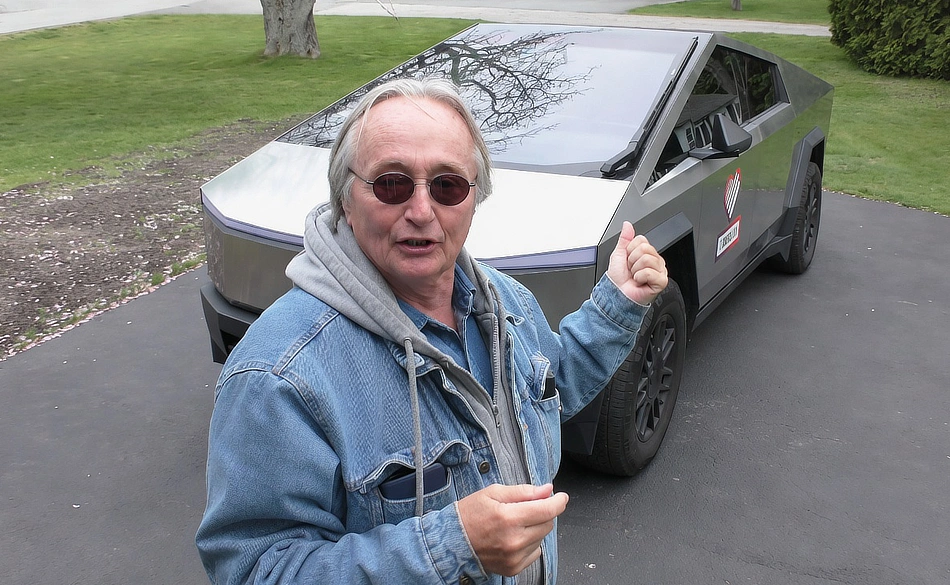
Scotty Kilmer has never been what you’d call subtle about cars, but even by his standards, the Tesla Cybertruck seems to have pushed him into a higher vocal register entirely reserved for collapsing exhausts and seized brake calipers.
Right from the off, he’s not impressed. The stainless-steel body — that “apocalypse-proof, bullet-resistant, space-age exoskeleton” — is, in Scotty’s world, basically a giant fingerprint magnet that somehow manages to look like it’s already been left outside in the rain for six months. According to him, it stains. It marks. It behaves less like a futuristic material and more like a fridge door in a student flat.
Then comes the performance art.
What follows is a mixture of disbelief, hollering, and what can only be described as high-pitched automotive distress signals as he declares the Cybertruck a “joke,” insisting it looks like a joke, drives like a joke, and may well have been designed by someone who has never actually seen a pickup truck before.
His next target is space — or rather, the lack of it. For something so aggressively angular and enormous on the outside, Kilmer argues the interior is unexpectedly tight, as if all that sci-fi origami didn’t quite translate into usable human volume.
And then there’s the numbers. Tesla’s bold promise of 250,000 units per year versus what Kilmer claims is closer to 20,000 in reality. In his telling, it’s less “industry disruption” and more “very expensive misunderstanding.”
By this point, the delivery has escalated into full mechanical panic — a man apparently unable to reconcile marketing ambition with physical reality.
If nothing else, the Cybertruck has achieved something rare: it has made Scotty Kilmer sound like he’s personally been cut off in traffic by the laws of physics themselves.