If you are looking to buy a Toyota RAV4, you will be hard-pressed to find one right now because production has stopped. But it isn’t all bad news: the sixth generation is about to be released. We don’t know the exact date yet, but Toyota says early 2026.
So we go back to the future to trial the fifth-generation RAV4. Apparently it’s consistently the world’s best-selling SUV, although that title occasionally swaps with the Tesla Model Y. In America it has even replaced the Ford F-150 pickup as the country’s best-selling vehicle. And in America that’s a big deal, because Americans love their pickup trucks.
So how does the current iteration of the RAV4 hold up?
The Exterior
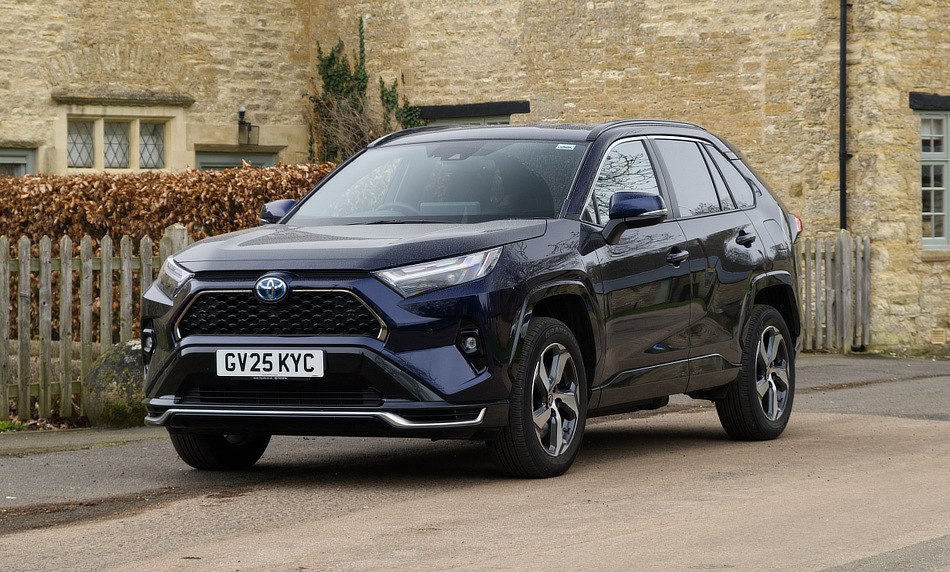
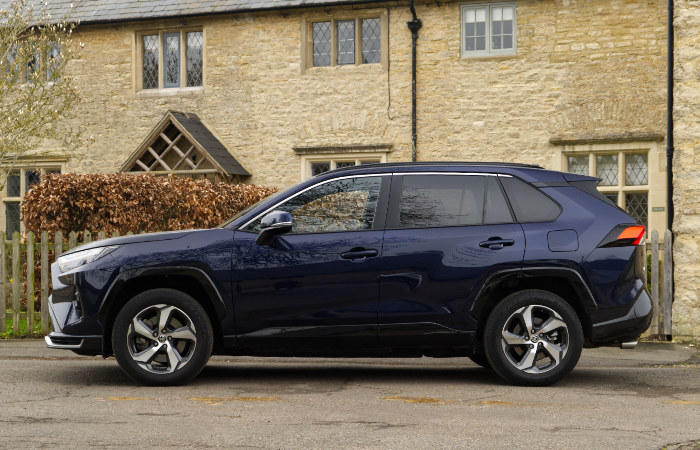
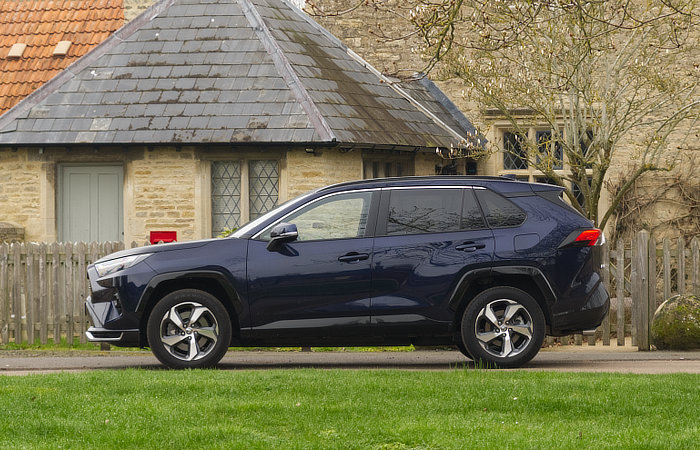
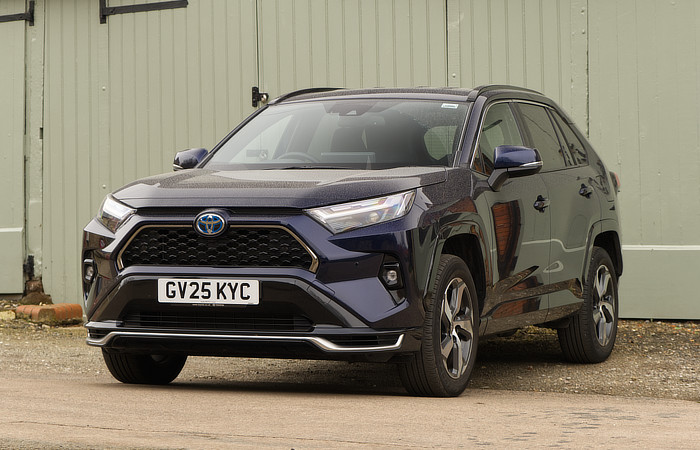
The fifth generation was introduced to the UK in 2019, with 2023 ushering in mild exterior and interior updates. On the whole it looks OK. Toyota introduced an origami-style design language and the RAV4 mirrors this philosophy.
It has a sort of functional yet stylish appearance and, in a crowded and generic-looking market, that gives it a unique profile.
In its current guise the RAV4 is available in four trim levels, with a choice of FWD or AWD hybrid and plug-in hybrid variants. Thankfully there are no diesel models.
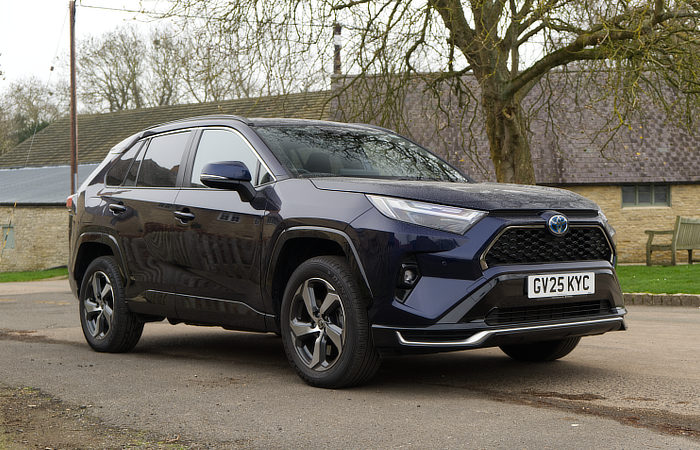
Pricing currently starts at £45,000 for the Hybrid. Standard features include privacy glass, roof bars, 18-inch alloy wheels, LED daytime running lights, and heated front seats.
The PHEV variant is available in two trim grades: Dynamic and Dynamic Premium, with on-the-road prices starting from £47,395 and £50,895 respectively.
Expect Toyota to continue this model trim and pricing format for the sixth-generation model when it launches this year. Although entry-level prices will likely rise, especially given the current situation in the Middle East.
The Drive
The RAV4 PHEV is powered by a 2.5-litre four-cylinder engine and features an 18.1 kWh battery pack, augmented by two electric motors. Power is channelled through a CVT transmission. To cut a long technical story short, total combined system power is 306 bhp and over 500 Nm of torque.
The first thing I noticed compared to previous generations is the improved drivability and low-end torque. With the engine and electric motors working in tandem there is barely any lag from a standstill. It has more than enough power, and it’s a quiet and refined powertrain.
When you do floor the throttle, only then will you hear the CVT-inspired engine drone, which is tolerable rather than insufferable.
As for handling, the RAV4 is set up for comfort — and I’m totally OK with that. Motoring journalists often want every car to handle like it “rides on rails”.
And while “riding on rails” may be aspirational, over the long term a sporty setup isn’t very liveable day-to-day in the real world.
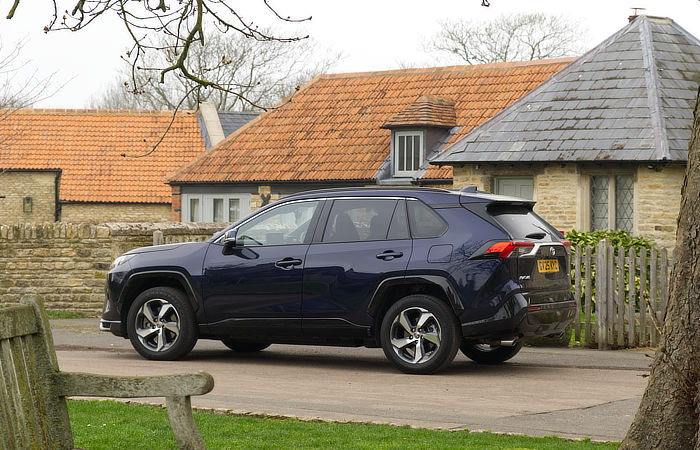
If you are tackling twisty country roads, the RAV4 will take you home without compromise because it has a solid chassis and suspension setup.
The ride and handling are well sorted for everyday real-world scenarios, and it has Germanic levels of motorway refinement. With three driving modes you can set the tone and delivery of power. Indeed, I switched to Eco mode for motorway driving because in Standard and Sport modes I often found myself going over the speed limit — the transmission and power delivery are that punchy.
Eco mode effectively detunes the engine and introduces a slight throttle delay, which is ideal to avoid inadvertently exceeding the speed limit and picking up a speeding ticket.
Steering feel? Good. Competent. Braking? It could do with a bit more feel at the initial bite point. And there is no regenerative braking — most PHEVs incorporate this function, but for this generation of the RAV4 it’s absent.
The Interior
It’s actually better than I anticipated. It feels less “Toyota-ish” than older models and falls into that grey area of feeling somewhat premium and somewhat plush. There’s a good mix of materials: soft-touch surfaces on the upper and lower dash and interior door panels, mixed with more utilitarian materials in areas you interact with less.
Overall it feels nice inside. As a comparison, it’s much nicer than our previous long-term VW Tiguan, although the cloth interior felt a bit VW-ish. It also has big, chunky rubberised dials for the heating controls, which will probably please a certain crowd, but it doesn’t offend me either way. The heated seat function uses an old-school click switch, which feels antiquated in today’s hyper-tech buttonless interiors.
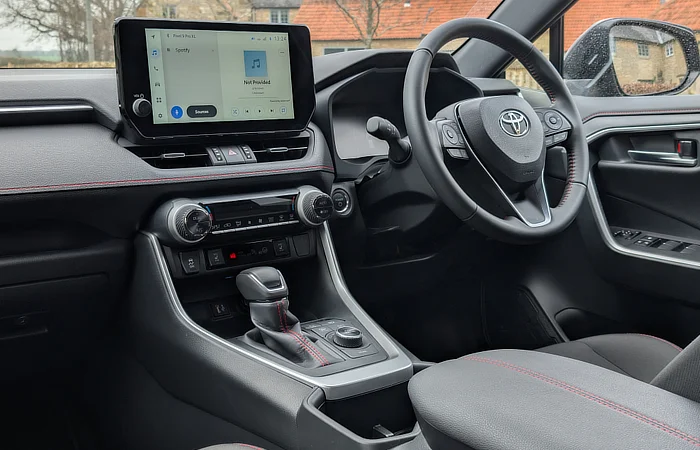
The 12.3-inch touchscreen infotainment system is fairly simple and features a small menu structure that is graphically well presented. Overall it’s easy to use and navigate. The digital driver’s display is sharp and clear and is configurable, although only to a limited degree.
You also get USB-C and USB sockets but no wireless charging pad. Apple CarPlay and Android Auto are notably absent. However, the native sat-nav is really good, and of course Bluetooth connectivity is present.
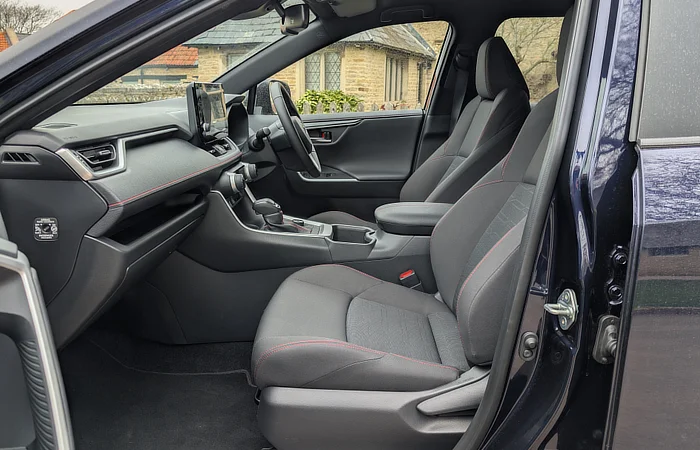
As for passenger space, it is more than big enough for the average-sized adult both in the front and the rear. The rear bench seats offer good support and a natural seating position, making long-distance journeys comfortable.
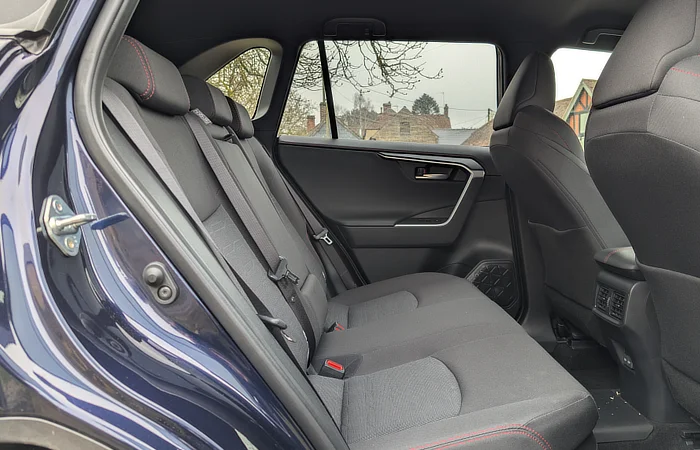
That said, hopefully Toyota improves the seat depth for better comfort, because posterior endurance fatigue begins to kick in after around 1 hour and 20 minutes of driving.
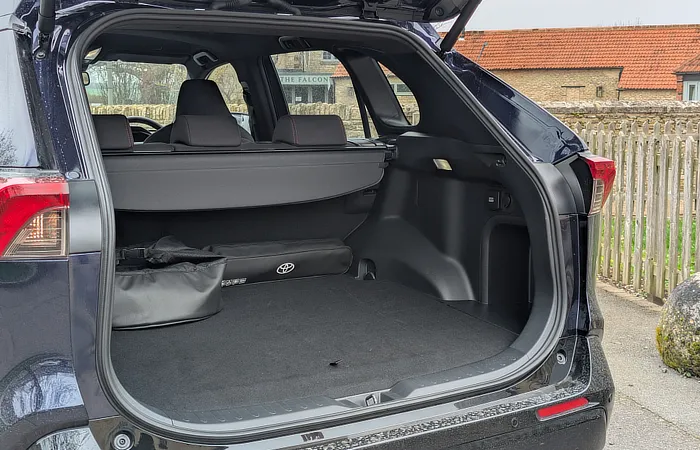
Boot space is predictably generous: 520 litres with the seats up and 1,604 litres with the seats folded down. Although I would have liked to see hooks to hold shopping bags in place.
The Efficiency
The fifth-generation RAV4 received a higher-output lithium-ion battery for the plug-in hybrid, increasing its energy capacity to 18 kWh. The battery can be fully charged in 2.5 hours using a 230 V/32 A wallbox charging unit.
Standard Type 2 cables are included for connecting the vehicle to a domestic power supply or wallbox. Toyota claims an official pure-EV range of 47 miles; in reality you’ll get a real-world range closer to 35 miles, which is still useful for day-to-day errands.
But most people who buy PHEVs are business owners who do so for tax reasons, meaning they don’t charge the battery frequently. That’s how I spent the majority of this test.
Despite the extra weight of the electric powertrain, the RAV4 returned 51.9 mpg in mixed driving (urban and motorway). Even everyday short errand runs returned between 48 and 50 mpg.
Even when the battery is fully depleted, the PHEV effectively reverts to a hybrid. That means you still get a small amount of battery assistance for low-speed manoeuvres from the battery reserve.
Epilogue
The fifth-generation Toyota RAV4 is a far more rounded and mature offering than I expected. Toyota has elevated the powertrain, driving experience, and overall package to a very accomplished level.
As an ex-Volkswagen Tiguan owner, I wish I had bought into the fifth-generation RAV4 instead.
The efficiency in all driving scenarios is consistent and underscores the engineering philosophy behind the RAV4. But more interestingly, the overall driving experience was far better than I expected.
While it may not be the most agile or balletic SUV, the Toyota RAV4 is arguably one of the most commanding SUVs in its class.