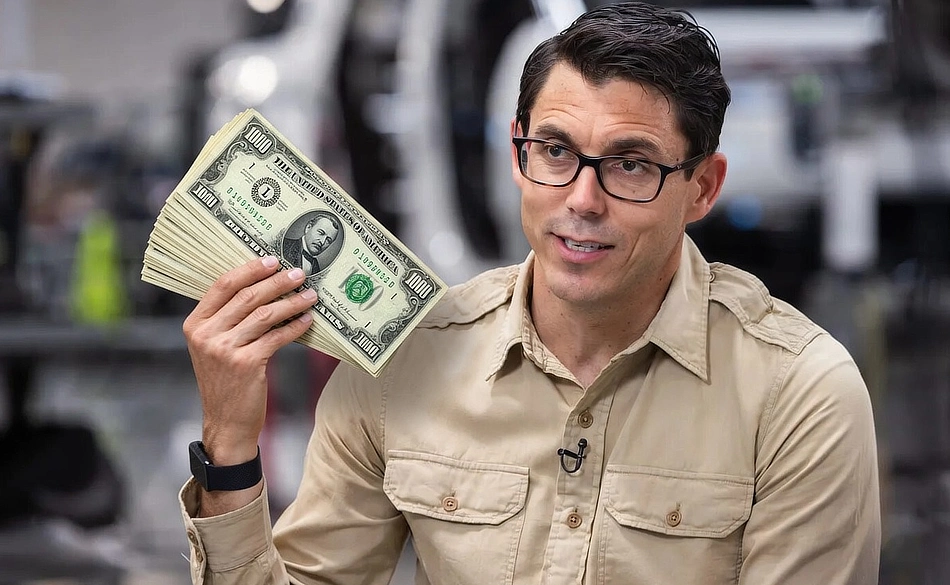
Rivian’s founder RJ Scaringe received a compensation package reported at $403 million in 2025, overwhelmingly in the form of stock options and awards tied not to present productivity, but to future valuation targets.
In other words, wealth is generated not by what the company produces, but by how convincingly it can narrate its own expansion to markets intoxicated by growth.
This is not remuneration in any traditional sense. It is a wager on perpetual escalation.
Such structures have become the defining logic of modern corporate governance. Executive pay is no longer anchored in the real economy—vehicles manufactured, wages paid, infrastructure built—but in the volatile abstraction of share price performance. The higher the perceived risk, the more lavish the potential reward. Instability itself becomes a monetized asset.
The logic extends further. Rivian’s board has already approved a package that could, under favourable financial conditions, reach into the billions over the next decade. The scale is so vast it ceases to function as income and instead becomes a claim on future wealth that has not yet, and may never be, created.
This mirrors the precedent set by figures such as Elon Musk at Tesla, where compensation schemes tied to extreme valuation targets transform corporate leadership into a form of speculative finance, indistinguishable from the markets they are meant to navigate.
What is obscured in this architecture of enrichment is the widening chasm between executive reward and social reality. The auto industry sheds labour, suppresses wages, and automates production, while simultaneously concentrating unprecedented wealth at its summit. It is a system in which risk is socialized downward and reward is privatized upward.
The numbers themselves are not the anomaly. They are the logic of the system made visible.