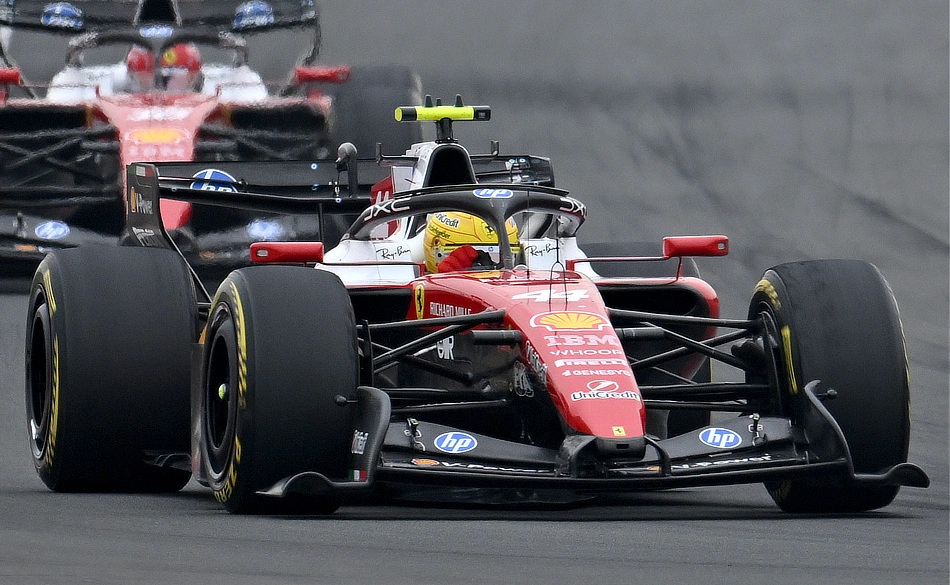

Ferrari is set to continue its aggressive 2026 power unit development programme, with a second ADUO (Additional Development and Upgrade Opportunities) update planned for after the summer break as it seeks to reduce the performance gap to its rivals.
Having been granted two development credits following the FIA’s post-Montreal assessment, Ferrari has already scheduled its first upgrade for Austria.
The initial package focuses on improving combustion efficiency through the introduction of a steel-alloy cylinder head, allowing engineers to operate the engine at significantly higher temperatures and pressures than would be possible with a conventional aluminium design.
For the Austrian Grand Prix, Ferrari will push its “hot engine” concept even further, increasing cylinder operating temperatures from 100°C to 110°C.
Combined with a Shell fuel formulation featuring a higher calorific value, the changes are designed to improve combustion efficiency, extract more mechanical work from the engine, and ultimately increase power output.
Higher operating temperatures also reduce cooling requirements, potentially enabling smaller radiators and more aerodynamically efficient bodywork.
A second update is expected to arrive at either Zandvoort or Monza and will focus on a redesigned turbocharger. Ferrari’s current turbo was deliberately designed with a smaller profile to minimise turbo lag following the removal of the MGU-H.
However, the FIA’s revised five-second pre-start procedure has largely eliminated that advantage by allowing all manufacturers sufficient time to spool up their turbochargers before the race start.
The new turbocharger will retain the existing impeller diameter but feature revised blade geometry and updated materials aimed at improving efficiency and overall performance.
While FIA data currently identifies the Red Bull-Ford power unit as the benchmark, many within the paddock continue to view Mercedes as the reference point. Ferrari’s objective with both ADUO upgrades is to narrow that gap and move closer to the front of the power unit battle.
The team’s recent progress in Barcelona offered encouragement. Through a combination of improved aerodynamics and more efficient cooling, Ferrari appeared to offset much of its reported power deficit, with the rumoured 25-horsepower shortfall to Mercedes becoming far less evident in the demanding Spanish conditions.
With Mercedes and Honda choosing not to utilise ADUO development opportunities, Ferrari sees a chance to gain valuable ground through continued power unit evolution during the season.