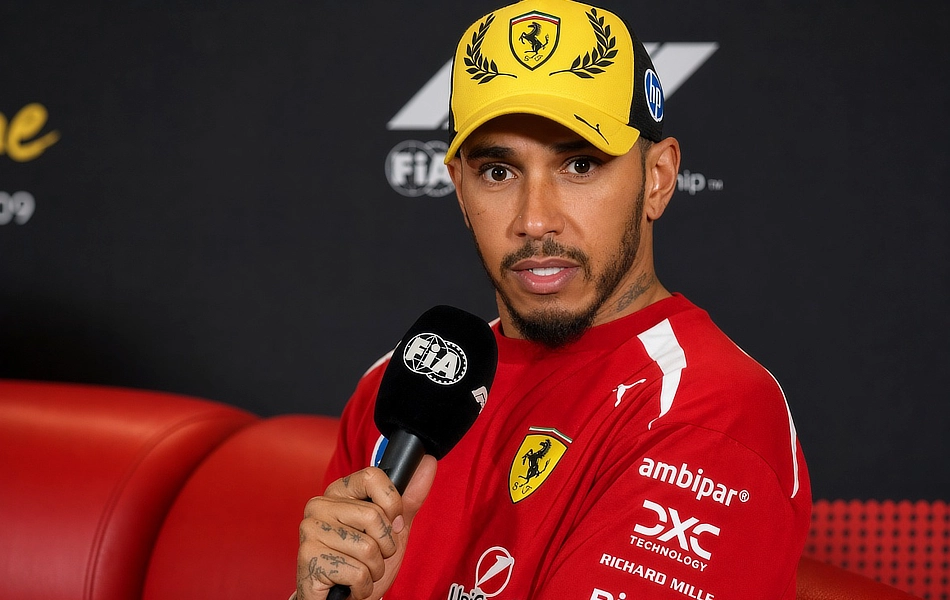

There are few names in Formula 1 that carry the weight of Ferrari. And there are few drivers who understand the pressure of winning quite like Lewis Hamilton.
That is why the events of the 2026 Dutch Grand Prix are so interesting.
History tells us that Ferrari has never been particularly comfortable when its drivers criticise the team publicly. Alain Prost discovered that in spectacular fashion in 1991.
Prost had spent the season struggling with Ferrari’s 643, a car that was simply not good enough. He made his feelings known publicly, famously describing the car as driving “like a truck”. Ferrari responded by sacking him just one week after the final race of the season, the Japanese Grand Prix.
Fernando Alonso later found himself in a similarly difficult relationship with Ferrari. He was openly critical of the team’s competitiveness, but his departure was ultimately negotiated by Alonso himself. There is an important distinction here: Alonso’s frustration was primarily about an uncompetitive car. Prost had publicly attacked the car itself.
For Ferrari, that distinction matters.
There appears to be an unwritten rule in Maranello: you can be angry, you can demand more, and you can push the team relentlessly behind closed doors. But publicly criticising Ferrari is another matter entirely.
Which brings us to Zandvoort.
A championship opportunity lost
Hamilton arrived at the 2026 Dutch Grand Prix sitting second in the championship. More importantly, Ferrari had a genuinely competitive car.
It might not be the fastest machine on the grid, but it is capable of fighting for podiums and, on the right weekend, victories.
Hamilton was therefore not simply fighting for another trophy on the shelf. He was fighting for an eighth World Championship, and every point matters.
During the race, Hamilton found himself behind teammate Charles Leclerc, who was running at a slower pace. From Hamilton’s perspective, getting past Leclerc was strategically obvious. If Ferrari wanted to maximise Hamilton’s chances of fighting for the championship, it needed to get its two cars into the optimal order.
Instead, the Ferrari pit wall hesitated.
And in Formula 1, hesitation costs time.
Hamilton spent too long behind Leclerc. The opportunity disappeared. The podium went with it, and Hamilton eventually finished fifth when second place had appeared to be within reach.
From inside the cockpit, Hamilton had seen the situation developing in real time. He was simultaneously driving a modern Formula 1 car at extraordinary speed, dealing with immense physical forces and managing tyres, traffic, energy and countless other variables.
The pit wall had the luxury of data. Hamilton had the steering wheel. Yet it was the pit wall that hesitated.
“A great way of wasting time”
Hamilton’s frustration was immediate. Over the radio, he told his team: “A great way of wasting time, guys. Good job.”
It was not a carefully constructed media statement. It was a driver’s reaction in the middle of a Grand Prix. Then came the chequered flag.
Hamilton’s engineer told him the team had been unlucky. Hamilton disagreed: “We weren’t unlucky. We lost time earlier on and that cost us P3. We can discuss it online.”
There was no ambiguity. Hamilton believed Ferrari had cost itself a podium. Later, in the media pen, he went a step further, saying Mercedes had executed its strategy better.
And that is where the Ferrari question begins.
Ferrari is Ferrari
Jean Alesi’s response perhaps summed up the Ferrari mentality better than anyone else.
“Ferrari is Ferrari.”
It is a phrase that encapsulates both the magic and the problem of the Scuderia.
Ferrari is treated differently from every other team. Its history is unparalleled. Its mythology is enormous. Its drivers are expected to understand that they are not merely driving for a racing team; they are representing an institution.
But there is a danger in that mentality.
Ferrari cannot demand that Hamilton operate at the absolute limit of his ability, maximise every opportunity and fight for an eighth championship while simultaneously expecting him to remain silent when the team makes a strategic mistake.
Losing is losing.
And if Ferrari wants to win the championship, the pit wall has to bring the same level of urgency that Hamilton brings from inside the cockpit.
Hamilton knows the clock is ticking
There is also another factor that makes Hamilton’s reaction understandable.
Time.
Hamilton is 41 years old. He is still capable of producing extraordinary performances, but he knows better than anyone that his window to win an eighth championship is not getting any larger.
Every race matters. Every podium matters. Every point matters.
When you have spent your entire career operating at the highest level of motorsport, being told after the race that you were simply “unlucky” is unlikely to make the frustration disappear when you believe the result was avoidable.
Hamilton’s outburst was therefore understandable. But understandable does not necessarily mean wise.
The Schumacher example
If there is one Ferrari driver Hamilton could learn from, it is Michael Schumacher.
Schumacher understood the political and cultural machinery of Ferrari perhaps better than anyone. His public message was almost always one of collective responsibility: we win together and we lose together.
That philosophy helped create one of the most dominant periods in Ferrari’s history. Hamilton would probably be wise to adopt some of that mentality. But there is a distinction between protecting the team publicly and allowing the team to escape accountability.
Hamilton can say “we win together and we lose together” while still telling Ferrari, behind closed doors, that it needs to be better. In fact, that might be exactly what Ferrari needs.
The apology matters — but so does the mistake
Hamilton has now publicly apologised for his comments. And an apology is an apology. The more interesting question is whether Ferrari will examine why Hamilton was angry in the first place. Because the uncomfortable truth for the Scuderia is that Hamilton’s frustration did not appear out of nowhere.
He was fighting for a championship. His teammate was in his way. The team had the data. The opportunity was there. And Ferrari hesitated. That is the part Ferrari should be analysing. Not merely whether Hamilton broke some unwritten rule about what a Ferrari driver is allowed to say.
The clock is ticking
Hamilton wants an eighth World Championship. More importantly, he wants to win that eighth title in red. That is why this relationship is so fascinating. Ferrari needs Hamilton. Hamilton needs Ferrari. But neither side can afford complacency.
Hamilton needs to understand that Ferrari’s culture demands loyalty, discretion and collective responsibility. Ferrari, meanwhile, needs to understand that it has recruited one of the most competitive drivers in the history of the sport — a driver who is not interested in simply making up the numbers.
The clock is ticking for Hamilton. He does not have the luxury of waiting patiently for Ferrari to get everything right. And Ferrari does not have the luxury of expecting Hamilton to simply accept mistakes because Ferrari is Ferrari. If the Scuderia really wants an eighth championship for Hamilton, it needs to remember one very simple thing:
The red car may be special. But the stopwatch doesn’t care.