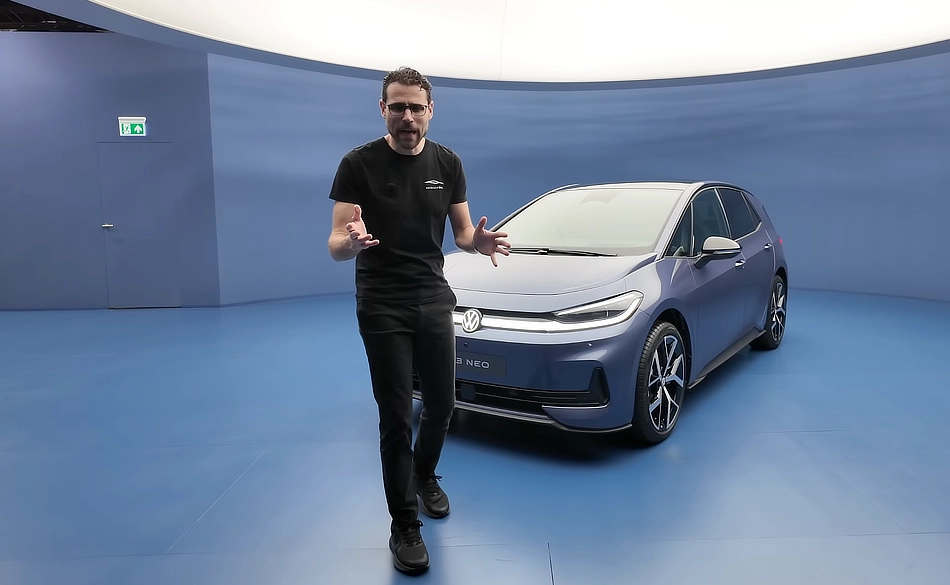
“Neo” means “new,” even in German. But there is something hollow in the promise. Thomas of Autogefühl turns his lens on the upgraded ID.3 Neo, a car Volkswagen would have us believe is the electric heir to the storied Golf. Yet what is presented as renewal feels more like managed decline.
Yes, the ID.3 Neo is rear-wheel drive across all variants—a technical note offered up as progress. And the battery has been reworked, now using LFP chemistry, with 50 kWh and 58 kWh options. We are told to expect over 295 miles in the city, or 199 miles in the compromise of combined driving. These are the metrics of modern faith: range, efficiency, incremental gain.
But the deeper story lies elsewhere. Volkswagen has reintroduced physical buttons—an act framed as listening, as responsiveness. In truth, it feels less like innovation and more like retreat, a quiet admission that the future it once tried to impose was not fit for human hands.
The interior speaks in the language of austerity. It is sparse, restrained, and unmistakably shaped by cost-cutting. This is not minimalism as philosophy, but as necessity—an erosion dressed up as design.
And beyond the showroom, the world has changed. Chinese manufacturers, unburdened by legacy and sentiment, move faster, build cheaper, and often build better. Against them, the ID.3 Neo feels less like a bold step forward and more like an artifact of an industry struggling to remember what progress once meant.