Humanoid robotics are closely aligned with autonomous-driving technology. Sensors, perception, real-time decision-making and machine learning are fundamental to both. In many respects, they are different applications of the same underlying technological stack.
That is what makes humanoid robotics so fascinating. The advances being made in robotics will increasingly transfer into vehicles—and the advances made in autonomous vehicles will flow back into robotics. Each field is effectively accelerating the other.
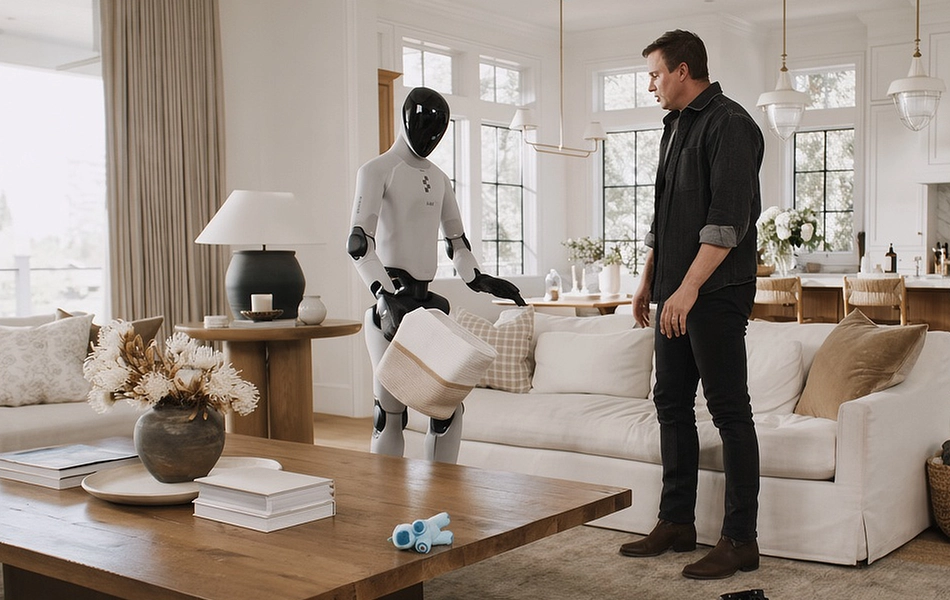
Consider what is already happening. Figure.ai is a US robotics company has developed a humanoid robot that is undergoing continuous real-world testing. The robot can perform manual tasks around a home and has completed four hours of continuous work without additional training.
That is impressive. But it also highlights the next major constraint.
Robotic articulation is advancing rapidly. The machines are becoming more capable, more precise and increasingly able to operate in unstructured environments. The bottleneck, however, is shifting toward computation.
For an AI-driven humanoid to perform complex tasks in real time—with the speed, adaptability and efficiency of a human—it will require vastly greater computational capacity than is currently available.
The latest generation of processors is extraordinarily powerful by historical standards. But that is almost beside the point. The trajectory of humanoid robotics implies a demand for computation on an entirely different scale: more sensors, more data, faster inference, greater memory and dramatically lower latency.
In other words, the physical robot is only half the story.
The real technological race is increasingly about giving the machine enough computational intelligence to understand its environment, anticipate what happens next and act accordingly—all in real time.
What Figure represents is therefore less a finished product than a snapshot of an emerging technological curve. The machines we see today are impressive, but they are primitive compared with what becomes possible when robotics, AI and computational power converge.
And there is an important lesson buried in all of this.
The harder engineers try to replicate human beings, the more extraordinary human biology becomes.
A human can see, interpret, balance, manipulate objects, learn from experience, adapt to unfamiliar environments and make thousands of decisions without consciously thinking about any of them.
We take this capability for granted because we are born with it.
Building a machine that can do the same is proving to be one of the most difficult engineering challenges of the modern era.
The humanoid robot is therefore not simply a new machine. It is becoming a benchmark against which we measure the extraordinary complexity of ourselves.