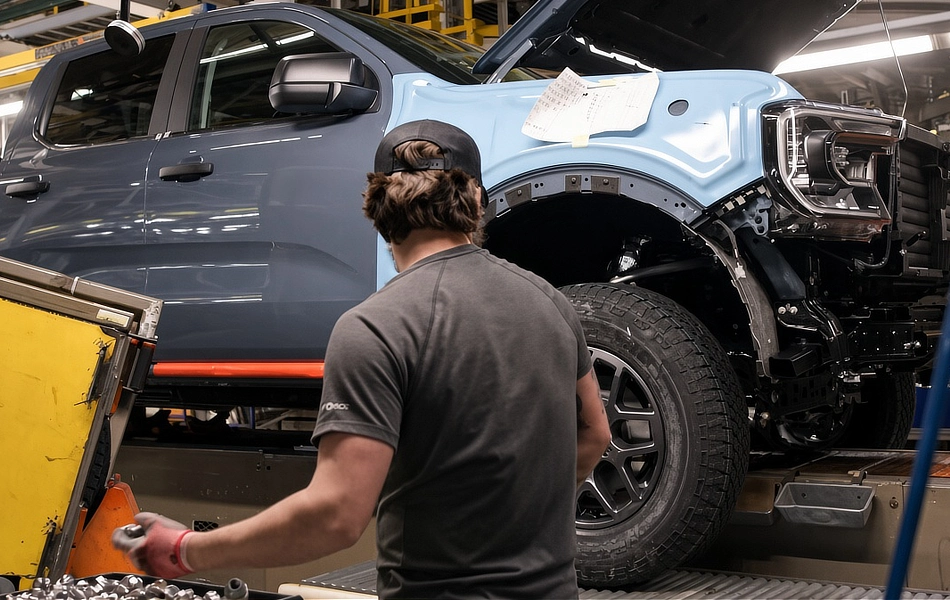
Ford has begun manufacturing lithium iron phosphate (LFP) battery cells at its new Michigan facility, marking a significant milestone for American battery production and bringing its affordable Fathom electric pickup a step closer to reality.
The cells are being produced at BlueOval Battery Park Michigan in Marshall, using technology licensed from Chinese battery manufacturer CATL.
They will initially supply prototypes of the Fathom, an electric pickup scheduled to reach customers in late 2027 with a starting price of US$28,350.
Ford says the factory can produce 40 prismatic cells per minute, with AI-powered inspection systems designed to identify microscopic defects and achieve exceptionally low failure rates.
The Fathom will use a structural cell-to-pack battery design, integrating the battery enclosure into the vehicle floor. Combined with two aluminium unicastings, the architecture eliminates 146 individual components.
Ford is targeting more than 300 miles (483km) of EPA range for its long-range version, with preorders expected to open in early 2027.
However, the project has endured considerable political and financial turbulence. Originally announced as a US$3.5 billion, 35GWh facility in 2023, it was subsequently scaled back to US$2 billion and 20GWh following scrutiny over CATL’s involvement.
Ford is also looking beyond electric vehicles, applying its Michigan manufacturing experience to a planned stationary battery storage facility in Kentucky.
The achievement is significant, but comes with an uncomfortable irony: America’s push for battery independence relies on technology licensed from China.
Ford may be making the cells at home, but catching up with Chinese battery expertise remains a considerable challenge.