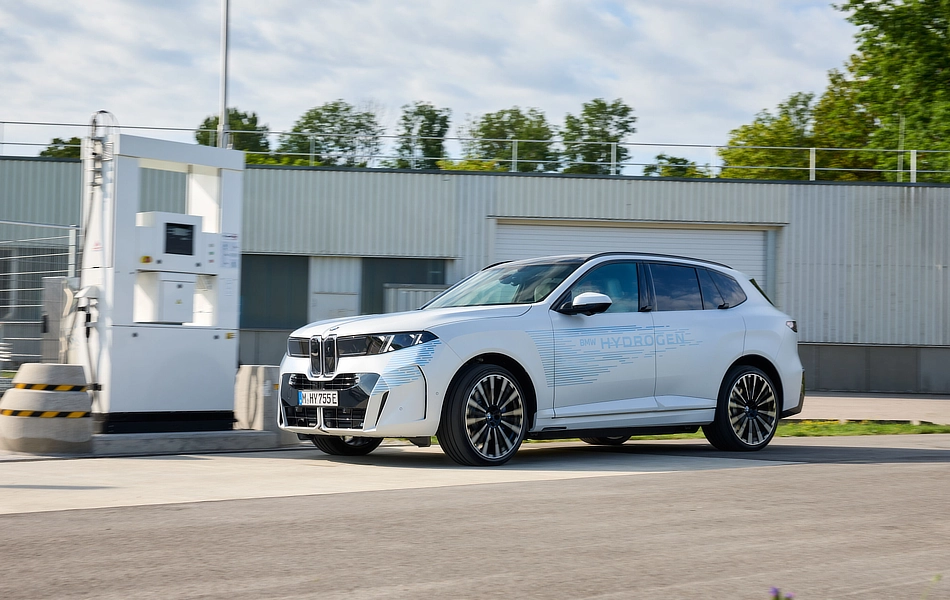
BMW’s Hydrogen Fantasy: The Infrastructure Simply Isn’t There
BMW continues to talk up hydrogen as though it is some inevitable part of the automotive future. But look at the numbers and the argument starts to fall apart.
Europe had just 186 publicly accessible, operational hydrogen refuelling stations as of May 2025.
By comparison, the European EV charging network has exploded to well over one million public charging points. The EU27 alone reached approximately 1.16 million public charging points in August 2026, while the wider European network is around 1.3 million.
And this isn’t simply an infrastructure problem that will magically disappear.
Hydrogen stations are expensive, complicated pieces of infrastructure, and the network remains tiny. The European Union has actually had to legislate minimum hydrogen infrastructure targets for 2030, including stations along major transport corridors.
Now BMW wants us to get excited about the iX5 Hydrogen: up to 750 km of range, less than five minutes to refuel and BMW driving dynamics.
Fine. The vehicle may be technically impressive.
But where exactly are you supposed to refuel it?
That’s the elephant in the room.
BMW is spending enormous engineering resources developing a sophisticated fuel-cell vehicle for a market whose supporting infrastructure remains minuscule compared with battery-electric charging.
And America doesn’t suddenly solve the problem either. California — by far the most developed hydrogen-car market in the United States — had only 42 hydrogen stations open to the public as of November 2024, with numerous others offline.
The California Energy Commission has also reported problems including equipment failures, maintenance issues, supply-chain constraints and hydrogen supply disruptions.
This is the fundamental problem with the hydrogen passenger-car proposition.
A battery EV plugs into an electricity network that already exists almost everywhere.
A hydrogen vehicle requires an entirely separate fuel-production, distribution, storage and dispensing infrastructure to be built essentially from scratch.
BMW calls this “technology openness.”
I call it betting on a technology that has spent years failing to establish the basic infrastructure required for mass-market passenger cars.
That doesn’t mean hydrogen has no future. It may have important applications in heavy transport, industry, shipping or other areas where batteries are less practical. Even current industry investment is increasingly focused on those harder-to-electrify sectors, while high costs and insufficient demand remain significant obstacles.
But for ordinary passenger cars?
BMW needs to explain why consumers should buy into a technology with hundreds of refuelling stations when battery-electric vehicles already have more than a million public charging points across Europe.
The iX5 Hydrogen may demonstrate some impressive engineering.
But engineering a brilliant car is one thing. Building an entire energy infrastructure around it is another.
BMW may believe hydrogen is part of the future.
The numbers suggest that, for passenger cars, the future is overwhelmingly being built around batteries.