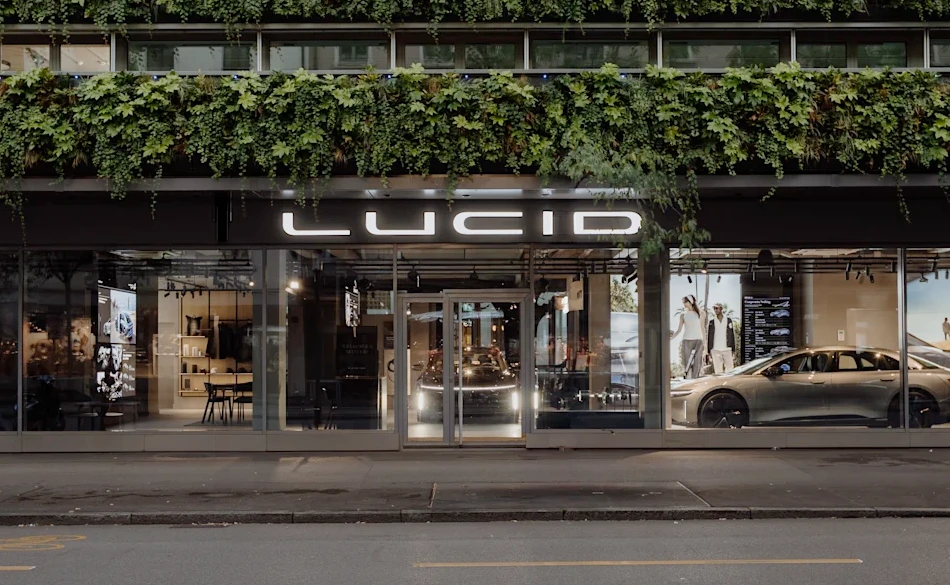
What we’re seeing here with Lucid is not just a “bad quarter” or a “temporary setback.” It’s a fairly textbook example of how industrial production in a high-tech industry remains deeply unstable, even when the narrative is one of innovation and rapid growth.
Lucid Group reports revenue far below expectations—$282.5 million versus $440 million anticipated—and immediately the market reacts: the share price drops sharply. But the deeper issue is not simply “missed forecasts.” It is the underlying fragility of a production system dependent on long, complex, and fragile supply chains.
A single supplier issue—in this case, a seat component affecting the Gravity SUV—was enough to disrupt deliveries significantly. That tells us something important: modern EV production is not fully under the control of the firm itself. It is distributed across networks of subcontractors, each introducing potential points of failure.
At the same time, we see the pressure of investor expectations shaping corporate behavior. Lucid does not merely report results; it suspends forward guidance entirely. Why? Because expectations themselves become a financial force. The firm must constantly signal future profitability to secure continued access to capital markets.
Even with production rising sharply year-over-year, deliveries lagged—another contradiction. Goods are produced, but not realized as revenue because bottlenecks in circulation and logistics intervene. This gap between production and realization is precisely where corporate instability often emerges.
Meanwhile, the company raises over a billion dollars from the Saudi Public Investment Fund and expands credit facilities. This is not incidental—it reflects a structural dependence on large pools of financial capital to offset operational volatility. In effect, state-linked global capital is sustaining private EV ventures that cannot yet stabilize their own production and sales cycles.
So what looks like a “supplier issue” is really a surface expression of a deeper reality: an industry expanding faster than its productive coordination, disciplined by investor expectations, and continuously vulnerable to disruption at every node of its supply chain.