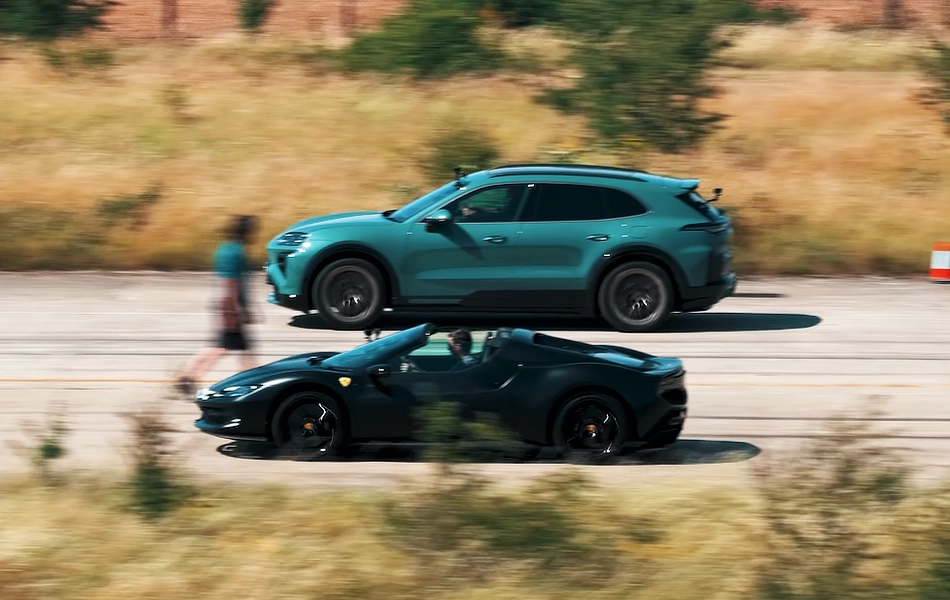
What happens when Italian supercar pedigree goes head-to-head with an electric family SUV weighing more than two and a half tonnes? You race them, obviously.
In one corner sits the Ferrari 296, a 3.0-litre twin-turbo V6 plug-in hybrid producing a colossal 830hp and 740Nm. Power goes exclusively to the rear wheels through an eight-speed automatic gearbox, while launch control helps the 1,640kg Ferrari make the most of every last horsepower.
It’s spectacularly engineered — and spectacularly expensive, with a price tag of around £279,343.
Then there’s the challenger: the all-electric Porsche Cayenne EV. It may look like a family SUV, but underneath are two electric motors producing an astonishing 1,156hp and 1,500Nm.
That gives the Porsche a huge 326hp advantage and more than twice the Ferrari’s torque. Better still, all-wheel drive means it can deploy that instant electric shove with considerably more traction.
There is, however, one rather large problem.
The Cayenne EV weighs approximately 2,645kg — around a tonne more than the Ferrari.
So we have lightweight Italian engineering against brute-force electric power. Rear-wheel drive versus all-wheel drive. A screaming V6 hybrid against near-silent instant torque.
And, crucially, a £279,343 supercar facing a £130,900 electric SUV.
On paper, this shouldn’t even be close. But paper doesn’t have a starting line.