Can a vehicle designed for war truly belong in peacetime?
It is an uncomfortable question beneath the polished language surrounding Team Grenadier. The consortium talks about resilience, operational readiness, supply-chain security and mission capability.
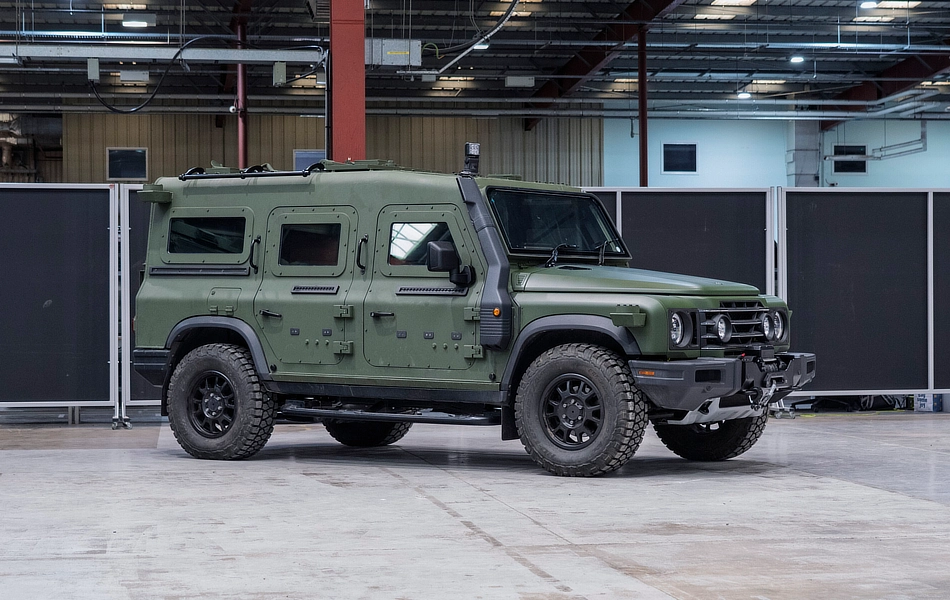
The Grenadier is rugged, adaptable and deliberately uncomplicated. It is designed to cross difficult terrain, carry equipment, withstand punishment and keep moving where an ordinary vehicle might surrender.
But what, ultimately, is such a machine for? The answer is contained in the programme itself: military mobility.
And that creates an intriguing paradox. The ideal military vehicle is built for a war that everyone hopes never comes. It is an insurance policy made from steel, rubber and diesel — expensive, highly specialised and justified by a catastrophe we desperately want to avoid.
Team Grenadier is now assembling an impressive British industrial ecosystem around that proposition. INEOS Automotive, SMT Defence, NMS UK, Hobson Industries and TVS Supply Chain Solutions are combining manufacturing, defence expertise, refurbishment, logistics and parts management to ensure that the vehicle can remain operational throughout its service life.
From a military perspective, it makes perfect sense.
Modern armed forces cannot simply buy vehicles and forget about them. They need machines that can be repaired, supplied and sustained when roads disappear, communications fail and conventional infrastructure is no longer available. A military vehicle is only as useful as the supply chain behind it.
But there is a more prescient question here.
Does preparing for war preserve peace, or does the permanent preparation for war gradually become part of the machinery that makes war normal?
This is the uncomfortable territory of the military-industrial complex.
Defence companies do not create wars simply by manufacturing equipment. Nations have legitimate reasons to defend themselves, and history is littered with examples of countries discovering too late that peace cannot be guaranteed.
Yet there is an inherent contradiction in an economy that must prepare continuously for something it desperately hopes will never happen.
The Grenadier therefore becomes more than a 4×4. It becomes a physical expression of our relationship with fear.
We build the machine because we hope we will never need it. We maintain factories because we hope the factories will never have to operate at wartime capacity. We train soldiers because we hope they will never have to fight.
And perhaps that is the uncomfortable price of peace.
The Grenadier is a machine designed to be useful when civilisation’s ordinary assumptions begin to break down. It belongs to the world of mud, broken roads, logistics convoys and contested territory — a world most civilians will never see and desperately hope never to experience.
Yet in peacetime it sits quietly on display, gleaming under lights, its capabilities transformed into a sales proposition. That is the strange duality of military technology.
We celebrate its engineering precisely because we hope never to discover what it was truly built to endure.
Perhaps the Grenadier is not really a vehicle for war. Perhaps it is a vehicle for the possibility of war. And that may be an even more revealing thing to build.
It is a physical expression of an ancient contradiction: we build weapons because we want peace, while knowing that an industry built around preparing for war can never be entirely separated from the possibility of war itself.
Perhaps that is the true purpose of such a vehicle. Not to fight. But to wait.