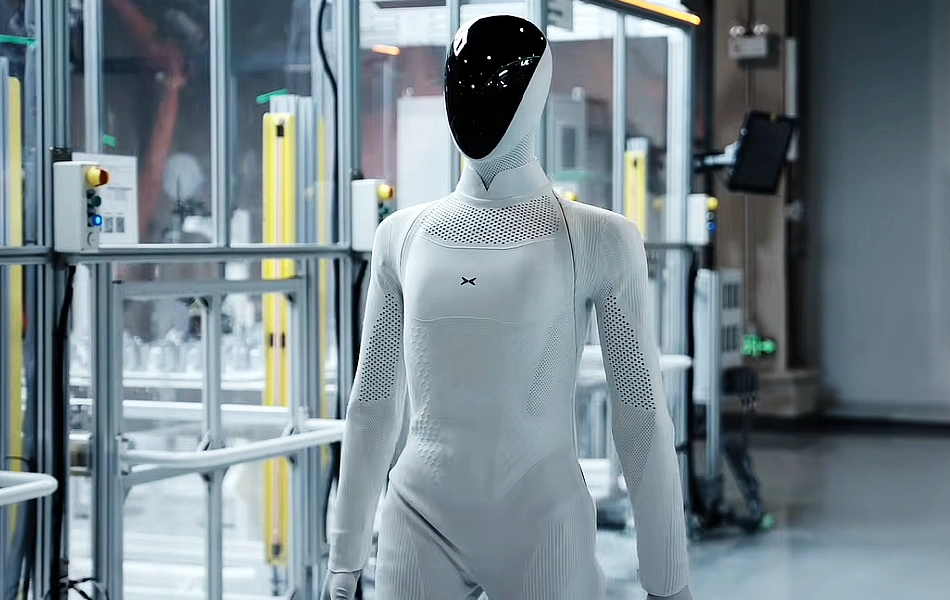
Xpeng makes electric cars. It also makes robots. At first glance, the two businesses appear to belong to different worlds. One moves people from A to B; the other is intended to move, think and eventually act in the physical world.
But Xpeng sees something fundamental connecting them.
Both require machines to interpret reality at extraordinary speed. A car navigating a road and a humanoid navigating a room are confronted with the same basic problem: the real world is unpredictable. It cannot simply be reduced to a script.
That is where the real challenge begins.
Humanoid robotics is advancing rapidly. Some of the earliest problems of movement are being solved, or at least coming within sight of a solution. Xpeng’s IRON humanoid robot, unveiled in November 2025, demonstrated an increasingly human-like walking gait.
But walking is only the beginning.
Xpeng is not interested in robots performing carefully rehearsed demonstrations. Its ambition is far greater: machines capable of operating in the real world as general-purpose robots, without constant human supervision and without needing every new situation to be individually programmed.
It sounds deceptively simple.
It isn’t.
To achieve that level of autonomy requires computing power on a scale far beyond what is readily available today. And that is perhaps the most intriguing part of the story. Computing technology is already astonishingly powerful, yet the gap between what machines can currently do and what humans do instinctively remains enormous.
As computing power increases over the coming years, robotic intelligence should increase with it. But nobody knows precisely what happens when that curve begins to bend upwards.
Perhaps the machines simply become better tools. Perhaps they become something fundamentally different.
For Xpeng, the difficult road is clearly the one worth taking. Building a genuinely general-purpose humanoid will require enormous resources, patience and technological breakthroughs.
And perhaps that is the most humbling part of all.
We often marvel at how quickly machines are learning to imitate us. But the harder they try, the more remarkable the original becomes.
A machine may eventually learn to walk like a human.
The extraordinary thing is that we never had to teach ourselves how.