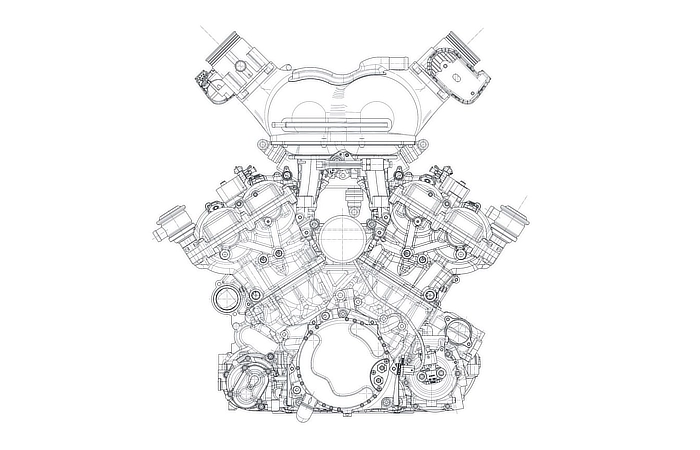
20,000 RPM.
That is an absurd number. At that speed, an engine isn’t really an engine anymore. It’s a very expensive machine for turning explosions into noise at an alarming rate.
And yet, back in 2006, Formula 1 got there. Mark Webber tested the 2006 Williams, which was powered by a Cosworth CA2006 — an engine that could spin to 20,000 RPM and became one of the highest-revving F1 engines ever built.
Which raises an obvious question.
If engineers managed 20,000 RPM nearly two decades ago, why haven’t we simply kept going?
Why not 21,000? Or 25,000? Or, if we have completely lost our minds, 30,000 RPM?
Because the problem isn’t getting an engine to spin faster.
The problem is keeping it in one piece.
As RPM rises, everything inside the engine has to accelerate and decelerate more violently. Pistons change direction thousands of times a minute. Connecting rods endure enormous loads. Valves have to open and close with ridiculous precision. Friction increases, temperatures rise and even the smallest amount of flex or imbalance becomes a very big problem indeed.
And then there is the simple fact that the piston has to travel up and down the cylinder incredibly quickly.
Eventually, physics sends you a bill.
Formula 1 eventually imposed a 20,000-RPM limit in 2009, and modern regulations subsequently pushed the ceiling lower still. Hybrid power has also changed the game, allowing manufacturers to extract enormous performance without relying solely on screaming engine speed.
So 20,000 RPM isn’t some arbitrary magical number. YouTube channel explains the physics behind the madness.